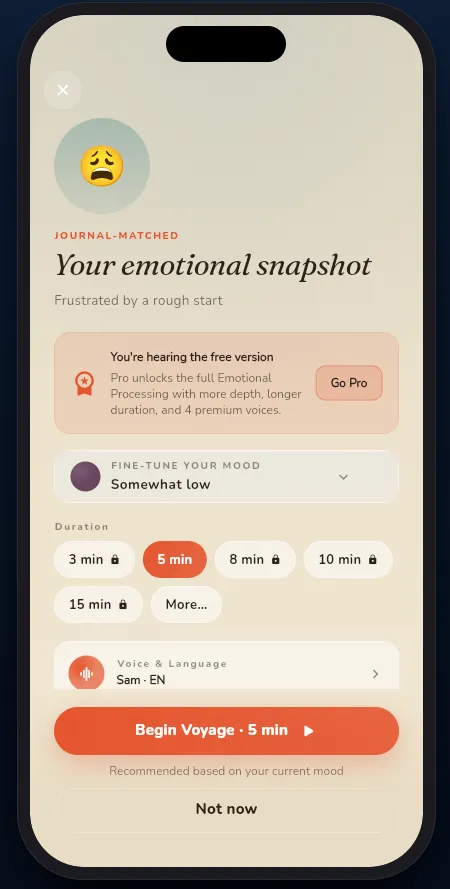
I meditated most days with Calm and Headspace before I built anything. Shora is not a guess at what people might want. It is the fix for a problem I hit every morning.
I was journaling to work out how I actually felt. Separately, I was practicing mindfulness meditation. The journaling told me something true, and then the meditation ignored it completely.
Calm was a hot mess of a library, full of practices of different kinds, many of them essentially the same thing. I started two or three separate journeys in there that taught me the same lesson, generically, and none of it was aimed at what I needed that day. Headspace was tidier, but it still had no way to pick for me. And in both, the multi-track courses were hard enough to keep track of that I lost the thread.
So I would choose a focus session before work. I wasn’t unfocused. I was tired. Other mornings I needed picking up and I picked breath counting, which settled me further down. I was diagnosing myself badly, at exactly the moment I was least equipped to do it well.
The obvious idea was to join the two habits. Write the journal entry, then have the meditation be about what you wrote. That is what most AI meditation apps sell right now, and I built it.
It made things worse. Hearing my own worries repeated back to me in the middle of a session kept my mind circling them. The point of the practice is to quiet that chatter, and I had built something that fed it instead. It was also slow, because generating a fresh script every time meant waiting for it.
So I threw it out. The journal is now only ever used to read your mood. The words you hear come from a fixed library, and they never mention your day.
At the start I had no access to a specialist who could write me a guided meditation for every mood and every intent. That constraint shaped the whole product, and I think it made it better.
Around that time I was listening to the Huberman Lab podcast, which kept coming back to specific breathing and visualization protocols for calming down or waking up. I tried them on myself. They worked. So instead of inventing content, I compiled the ones that had been studied and published, and matched them to moods and goals. Most of them turn up inside ordinary mindfulness meditation anyway, which told me I was on the right track.
That has changed since. A meditation specialist works on the scripts now, and it is the single biggest difference between the first version and the one you would install today.
Those techniques became the library, and the sessions that sequence two or three of them together. Every technique still carries its evidence grade, Strong, Moderate or Emerging, and a link to the paper. You can read the research without taking my word for any of it.
Just like in therapy, not every patient responds to the same treatment equally. That is the idea the whole app rests on. So every session ends by asking whether it worked.
If box breathing didn’t calm you down, next time Shora tries cyclic sighing instead. If that lands, it reaches for it more often. Oversimplified, but it paints the picture. Nobody has to tell Shora what works for them. They just have to say whether it did.
A beach is my safe place, and my favorite spot to practice. Two phrases have stuck with me for years. One is “I am but a fragile wreck on a storm of emotion.” The other is “painting an emotional picture.”
Shora is the shore. The app is there to help you cross a storm of emotion and get to it. The painted look came from the same place, watercolor at first, and later something closer to oil.
People will not close their eyes. Nearly every exercise asks them to, and a good number simply don’t. That broke an assumption I had baked in, because the breathing orb in the player was never synced to the instructions. Nobody was supposed to be watching it. I’m fixing that now.
I also don’t much like the SOS widget and the minimal player. I wanted to redo them. People use them and say so, so they have stayed exactly as they are. My taste lost, and it should have.
And the single most requested thing was shorter sessions. So there are three minute ones now. Longer is better if you have it, and most days you don’t. A short breathing practice is not a consolation prize. It is one of the best studied things in the library.
Shora is out on both stores and it improves most weeks. It is early, and I would rather say that than pretend it is finished. If something in it is wrong for you, tell me and it will change.
support@shoraapp.com goes straight to me. If you have a question first, it is probably answered here.